
Climate Leadership and the Strength of Acting in Community
By Leah Reesor-Keller, ACC Interim Executive Director
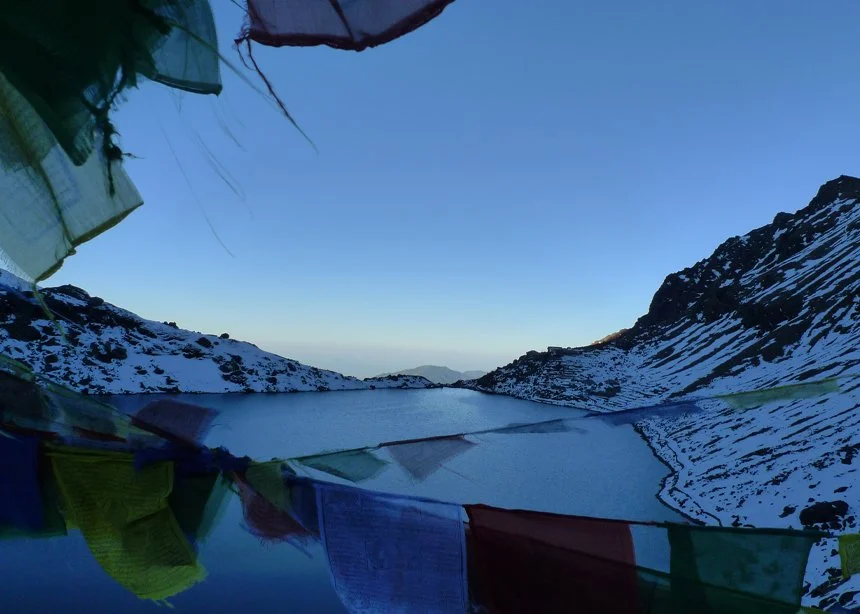
Prayer flags at Gosainkunda glacier-fed lake in Langtang National Park, Nepal. Located at an elevation of 4,380 metres, Gosainkunda is within the Langtang subrange of the Himalayas where a glacial collapse unleashed devastating flooding in August 2026. Photo: Leah Reesor-Keller, October 2014. This article was first published online in Canadian Mennonite, Oct 1, 2026.
Back in the summer and fall of 2023, when I was drafting the book Tending Tomorrow, I was confident I was getting the facts right. But I wanted to be wrong.
During the five years I lived in Nepal working on agriculture and rural community development programs with Mennonite Central Committee partners, I had seen first-hand the close and precarious relationship between the glaciers of the Himalayas and the water supply that everyone relies on. Research institutes were already monitoring glacier melt rates and assessing disaster risks.
I wrote in Tending Tomorrow about my fears that melting glaciers could wreak havoc on communities below the glaciers.
Three years later, those distant worries are coming to life. Nepal’s devastating Bhote Khosi floods and landslides on August 26 were likely caused by a collapsed glacier near Langtang Lirung peak. A week later, the United Nations Environment Programme released a report that confirms that passing the dangerous 1.5°C mark in global average temperature rise is now unavoidable. Scientists have long warned that this is the threshold over which we will experience massive upheaval to our planetary systems that function as our global shared life support.
My friend and a colleague from my time in Nepal, agriculture expert Shiva Shankar Sharma, wrote:
The Bhote Khoshi disaster is a painful warning from a warming Himalaya. Nepal has contributed little to global emissions, yet its people face the consequences through melting glaciers, floods, landslides and growing loss and damage. The world must listen: climate change is not tomorrow’s crisis—it is today’s reality. Nepal is not asking for charity. It is demanding climate justice.
The good news is that, globally speaking, we know what is causing the problem, and we know how to solve it. There are many solutions to help the world transition to a climate-safe, decarbonized future.
As I wrote in Tending Tomorrow, at the core, this is a leadership issue. It is time for a re-frame, I believe, from climate action to climate leadership, centred on principles of justice, repentance and transformation for the common good of human and all life on this planet.
Showing climate leadership is about demonstrating what is possible as we act towards that good future for all. It shifts the driving question from “Are we doing enough?” to “Are we leading the way to the future we want?”
In my role with Anabaptist Climate Collaborative (ACC), I get to witness climate leadership happening in faith communities across Canada and the US. And there is a lot happening:
Schools like Rockway Mennonite Collegiate in Kitchener, Ontario, and churches including my own congregation, Erb Street Mennonite Church in Waterloo, Ontario, have solar panels that not only generate carbon-free power but also show the surrounding community that these Mennonite-affiliated folks are committed to a greener present and future and are already taking action on their own.
Mennonite Central Committee US and ACC supporters took part in a lobby day in Washington, D.C. in July, advocating to US lawmakers to support mining reform so that an increase in mining for minerals for renewable energy technology doesn’t replicate harmful patterns of extraction that poison rivers and people.
Volunteers with Mennonite Disaster Service continue to respond in practical ways to the impact of floods, hurricanes and wildfires across Canada and the US.
People of faith are organizing to make climate action and environmental protections into key campaign issues in municipal and provincial elections happening across Canada this fall, and in the US midterm elections.
ACC, Mennonite Church Canada, Mennonite Central Committee and other Anabaptist partners are bringing together students and young adults from across the US and Canada for a climate, peace and advocacy gathering at Canadian Mennonite University in late October.
These are just a few examples of where I see climate leadership happening. It takes all of us coming together to address the losses and take action to reduce the current and future harms of a warming planet. There is a part for everyone to play, especially those of us who live in countries like Canada that have historically contributed much higher emissions than countries like Nepal that are experiencing so much climate change-related loss and damage.
This work is not easy, but leadership never is. It is about moving forward anyway and showing in all the ways that we can that there are other futures possible, while reaching out to support our local and global neighbours reeling from the impact of disasters like the flooding in Nepal.
I wrote these words back in 2023, and today they are more important to me than ever:
What matters is the commitment to keep showing up with others, to believing together that it is worth striving for things to be different from how they are. To begin living together as if the future we want is here. We need the moral support of community, the feeling of belonging to something bigger, the relationships in which we find joy and companionship along the journey, people to mourn with and people to rejoice with. To make the kind of changes at the scale we need, this work needs bigger and broader coalitions of people who learn from and challenge each other to go deeper into care and possibility, weaving together the fabric of community we need to live the alternative futures we imagine into being. I am not alone; we are not alone. We do this together embedded in the miraculous hospitality of our planetary home that sustains the only life known to exist anywhere in the universe. Holding on to connection, relationship and joy even in, especially in, times of suffering and grief.
Leah Reesor-Keller is the interim executive director of Anabaptist Climate Collaborative. She lives in Kitchener, Ontario, and attends Erb Street Mennonite Church in Waterloo, Ontario.